
-
Hello Music that Makes Community Friends,
As the current Monday Morning Grounding season comes to a close, we will be taking a summer break. After our summer break, Monday Morning Grounding will resume from August 25, 2025-December 8, 2025. Same Zoom link, same time.
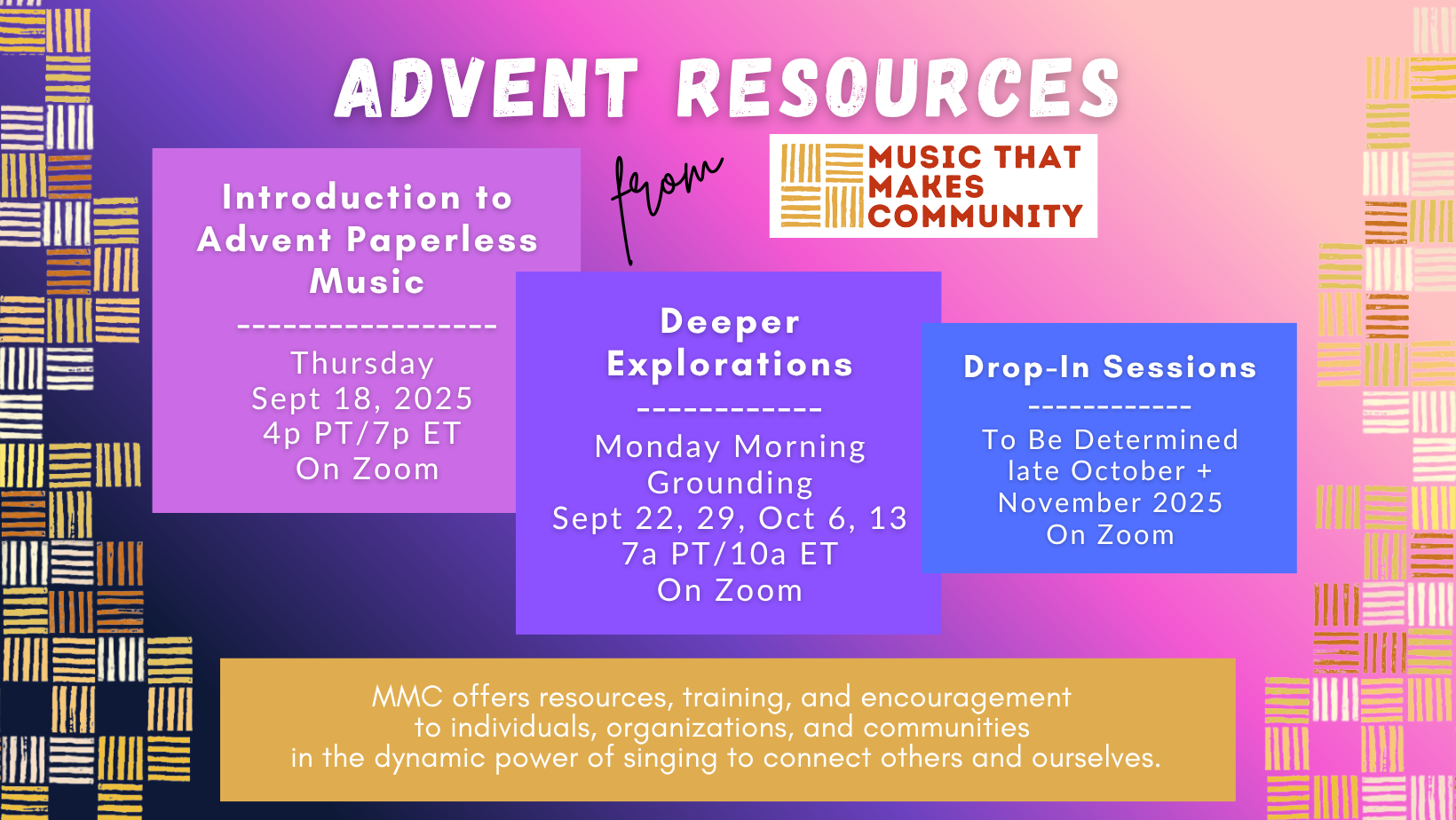 Monday Morning Grounding will be the space for four in-depth Advent song and text preparation sessions on September 22, 29, Oct. 6, 13, 2025 as a follow-up to our Introduction to Advent Paperless Music on Thursday, September 18, 2025 at 4 pm Pacific / 7 pm Eastern.
Those who show up find that they are fed, filled and grounded for the week ahead, particularly in these turbulent times. You’ll leave with a song to carry you through the week. If you can’t regularly make it to Monday Morning Grounding, we wanted to share the resources from this past season with you. Although they were particular to a day and this season, in some respects, they are timeless and timely songs and poems for the coming days as well.
-

Music that Makes Community facilitators from across the continent gathered via Zoom for a Facilitator Playlist Party to share Songs of Justice on April 29th. We had more songs than we could sing in an hour and a half, and new songs on the way, so consider this an introductory resource list for those of you who weren’t with us. We learned and sang these songs together:
-

Hello Music that Makes Community Friends,
As the current Monday Morning Grounding season comes to a close, we will be taking a break for Holy Week and Easter Monday. The late Spring/Summer season will start again on April 28th.
Those who show up find that they are fed, filled and grounded for the week ahead, particularly in these turbulent times. You’ll leave with a song to carry you through the week. If you can’t regularly make it to Monday Morning Grounding, we wanted to share the resources from this past season with you. Although they were particular to a day and this season, in some respects, they are timeless and timely songs and poems for the coming days as well.
-

Music that Makes Community facilitators from across the continent gathered via Zoom for a Facilitator Playlist Party on March 30th around the theme of Easter and Joy. We spent time connecting, singing, sharing songs, and learning more about what MMC is up to in this season. Here are some of the songs we sang:
-
Dear MMC Community,
When I attended my first Music That Makes Community event in 2017, it was both a revelation and a gift: our singing together is life-giving, spirit-growing, and community-building! I'm therefore thrilled to invite you to submit your chants, songs, and original music to Sing Out Love: a new, fully online hymnal published by the Unitarian Universalist Association.

-

We are pleased to let our MMC community know that your 9 member Board of Trustees is fully seated and ready to support the work of Music that Make Community. Please welcome new members Gordon Johnston, Liesl Spitz, and Amy Steenson. You can learn more about each of them, and the rest of MMC's board members, on the website at https://www.musicthatmakescommunity.org/people.
Music that Makes Community's Board of Trustees steward MMC's resources, work with our Executive Director with fundraising, programming, and administrative matters, and give their time, talent, and resources to special projects throughout the year. We thank them for their faithful service, and are looking forward to a great year ahead!
-

In mid February, Music that Makes Community Facilitators gathered for a playlist party around the theme of “Lent/Spring.” Here are some of the songs we sang:
-

So you want to sing MMC style regularly, locally? Or how could I start a local MMC community singing gathering?
We asked several local group leaders to share how and what they have been doing when things work. Spencer Foon from Chicago and Sylvia Miller-Mutia spent an hour with us. Board member Nancy Willbanks provides this summary of what they shared.

-

Every Thursday night for nearly thirty years, a widely diverse group of 30-100 people gather for worship and a meal at Idlewild Presbyterian Church in midtown Memphis. The irregularity of this service is that it is not comprised of members of the host church, but primarily filled with the men, women, and children of the streets of Memphis. The service is short and loosely follows the Presbyterian liturgy: an opening hymn, a sentence or two of confession and prayer, and an acclamation of pardon are followed by a statement of peace and symbolically passing this peace to those assembled. The second section begins with another hymn and contains a scripture selection and short sermon. After a third hymn, an invitation is issued to a communion table with the Eucharist taken by intinction. The leaders of the service are all volunteer lay persons, with an ordained minister who presides over the communion and for seven years I was one of them.
-

An Anti-Racism Triad
Reflection by Nancy Willbanks
 For the past year and nine months, I have been meeting monthly in an anti-racism triad. We each had participated in one of the several book groups reading My Grandmother’s Hands by Resmaa Menakem (link to Bookshop.org) under the auspices of Music That Makes Community in 2021 and 2022. (See more about forming a triad in this article: When White Bodies say, "Tell me what to do.")
 We meet on zoom. I knew Jeremy from Monday Morning Grounding, and I didn’t know April at all, before we started meeting. We made a commitment for a year, and we are still meeting because we all find the hour and fifteen minutes we spend together each month valuable. We live in Massachusetts, Arizona and South Dakota. We juggle competing schedules and time zones. We are all in ministry and ordained. Jeremy and I are pastors and April is a chaplain at a community hospital. Jeremy is in a community where the BIPOC population is primarily from the Lakota tribe, while April sees a broader range of ethnicities in the hospital setting, including Native Americans, Latinx, and Black. In my neighborhood, the BIPOC people I see or interact with are Asian (including my daughter), Black, and Latinx.
Each month we share some of our own noticings about racism that we have witnessed or heard or read about, and we share a somatic practice, often from My Grandmother’s Hands, and we share a song. Sometimes in between our meetings we text.