
-
At Music that Makes Community, we believe that people can build trust and connection by singing together. This often happens slowly in worshipping communities through routine, and repetition over the course of a long time. But in moments of urgent need, crisis, grief, or resistance, singing can bring people together quickly as well. Vigils, protests, rallies, direct actions, are all places where singing, and paperless music in particular, can be a powerful practical tool for collective participation.
There is a rich tradition of music from many times and cultures that has been used by groups of people coming together to work for collective liberation.
In the Hebrew Scriptures, Moses and Miriam mark the crossing of the Red Sea with singing; Shadrach, Meshach, and Abednago sing a song of praise to God from Nebuchadnezzar's fiery furnace in the book of Daniel, and in the Gospels, the crowds sang Hosannas as they welcomed Jesus to Jerusalem on Palm Sunday. Beyond Scripture, Paperless music has particular strengths that make it suitable for these moments.
1. Musical repetition and fewer words are easier when it is hard to hear. When a gathering is responding to an emergent need, the set up for sound is often sub-optimal. Events might happen outdoors, without amplification, in locations with lots of ambient noise. Repetition gives people more chances to hear, and then to participate, or even just hear what is being said.
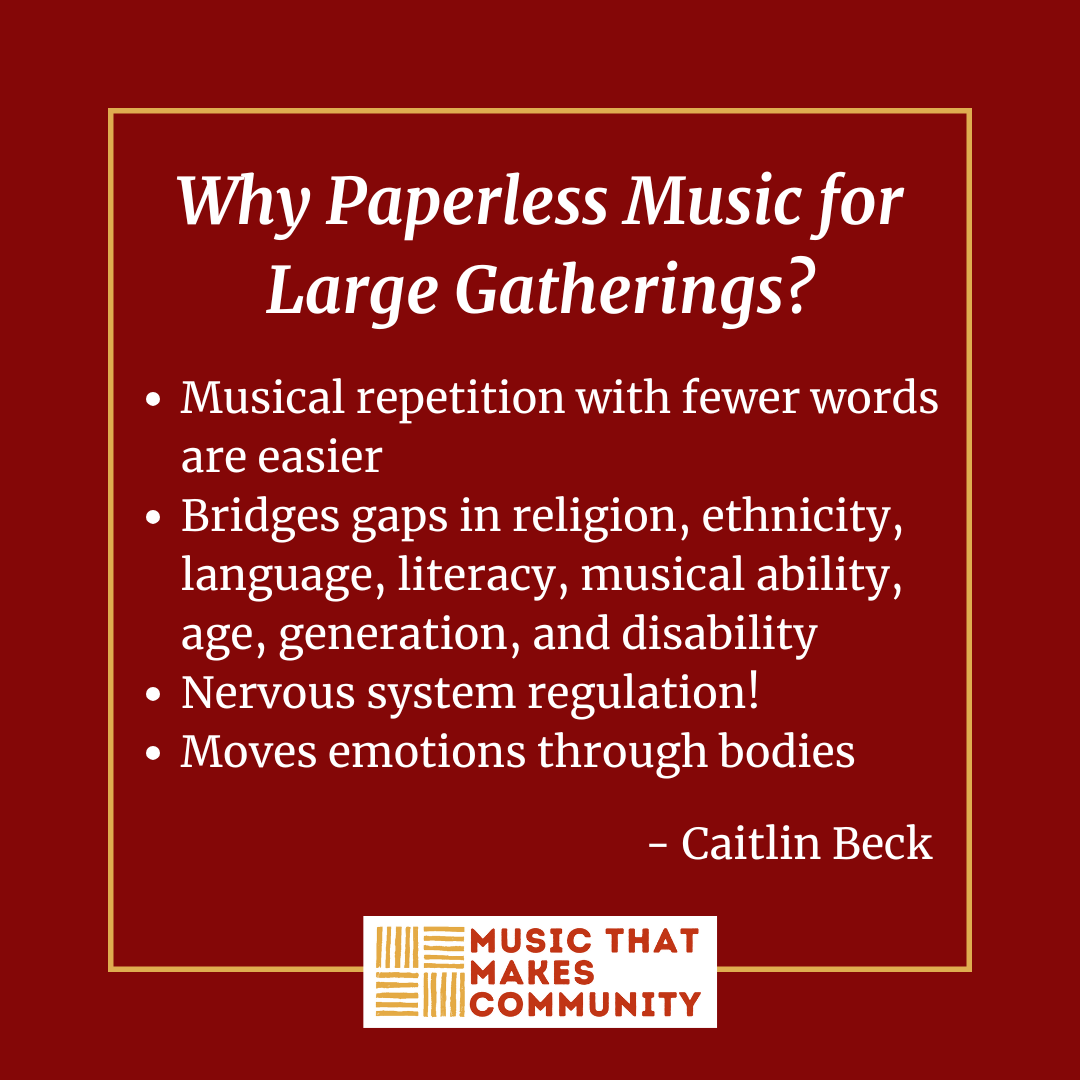 2. Large gatherings responding to urgent needs often bring together many people who may not know each other, or have the same abilities, identities, or shared culture. Paperless music can bridge gaps in religion, ethnicity, language, literacy, musical ability, age, generation, and disability that may exist between those participating. This inclusion allows more people to participate, more fully.
3. Singing can be an effective tool for nervous system regulation and co-regulation, helping to keep a large group of people, with urgent needs and strong emotions, focused on a shared action or message, even while in the midst of fight or flight mode in response to danger. The less energy a person needs to spend learning a new song, the more they have available to stay present to what is needed in the moment.
4. Speaking of strong emotions, singing can be an outlet for moving emotion through our bodies rather than keeping it pent up inside, as well as for accompanying someone who is feeling a different emotion from our own. For this reason, having a variety of songs that express different moods and emotions is useful for these gatherings, as well as paying attention to the general mood and needs of the group. Paperless music is flexible, we can make a song last longer or shorter, switch up the order of things, change words, share leadership. This makes it a responsive tool in leading a group whose needs are changing quickly.
Singing is an expression of human creativity - it can be beautiful and playful, and can convey meaning and shared values. It is a kind of alchemy, that is to say it has the power to create something completely new and precious, that is more than the sum of its parts.
Resources
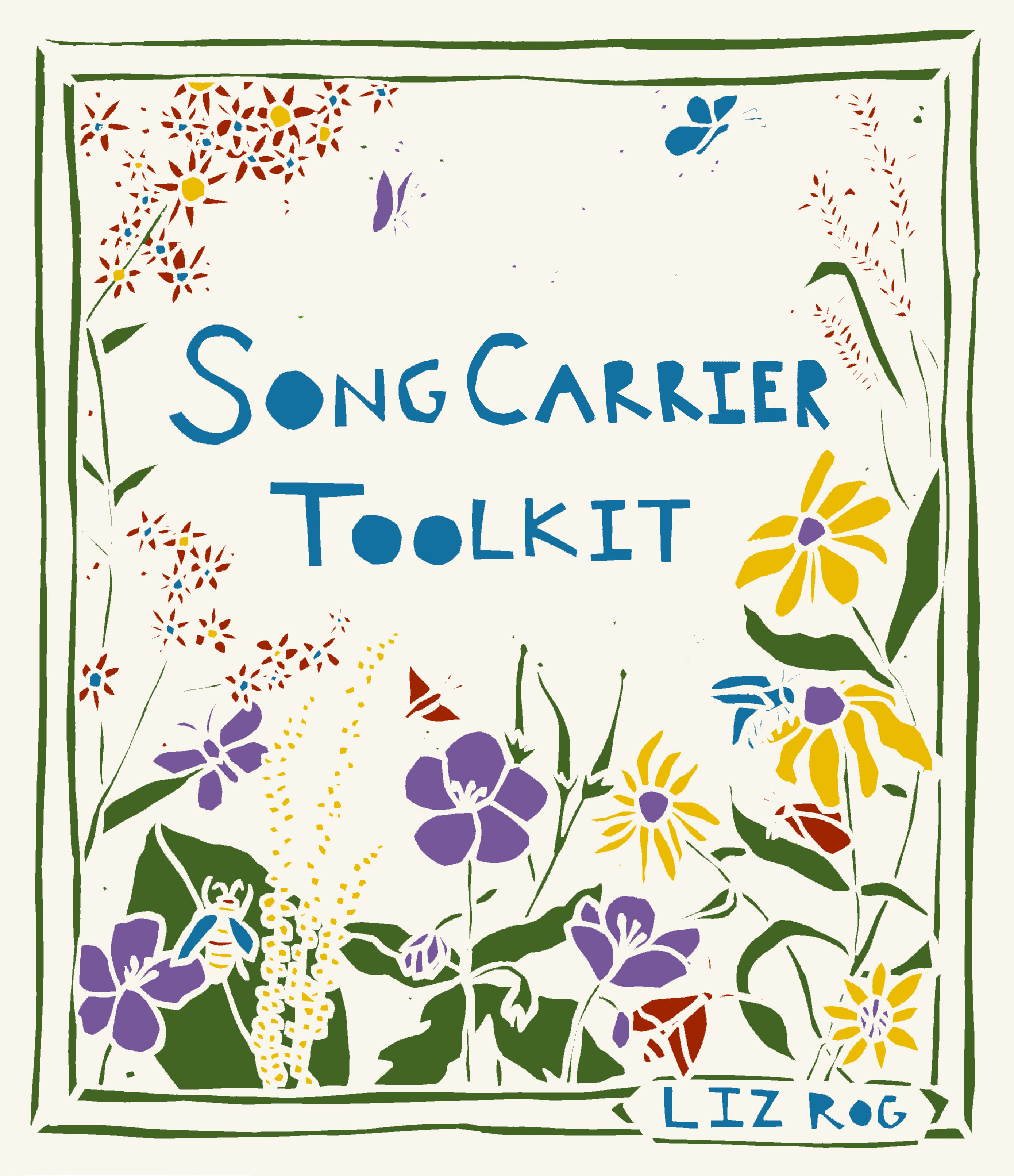 - To support your planning for singing at large gatherings, we are delighted to share this spreadsheet of Songs for Rallies, compiled by Music that Makes Community friend, Liz Rog, who also wrote the Song Carrier Toolkit (image: right).
 - If you’re looking for further inspiration, we encourage you to read Harmonizing Organizing Manifesto, by The Peace Poets’ Lu Aya.
 Caitlin Beck (they/she/he) is one of three co-pastors at Open Way Community Church in Vancouver, Canada and is part of the Salal and Cedar Watershed Discipleship Ministry. Originally from Ottawa, Ontario, Caitlin has degrees from Saint Paul University, and the Institute of Sacred Music at Yale University, in mission studies and interreligious dialogue, and liturgical studies respectively.
Do you like this post?
Showing 1 contribution